Tuesday, March 20, 2018

Of Trees and Leaves

"Fern Walk" was finished just in time to submit it to the Vancouver Island Surface Design exhibit, Pathways. I will hear at the beginning of April whether it's been accepted. But regardless of whether it is or not, I feel pleased with the result, which is part of my series, Field Notes from New Zealand. I do love working with indigo and bright colours, and know there will be new pieces from this series to show you during the course of this year. I've already got my ticket back to New Zealand at the beginning of October, (yay!!), and my two month stay will include a 10-day artist's residency at the New Zealand Pacific Studio. So exciting! My work there will be to continue with this series, including collecting more ferns, and using cyanotype printing  to record their details. And then incorporating them into my work.
This is a detail of "Fern Walk", and shows you some of the hand-stitching and the "rocks" that delineate the path. I tried putting real rocks I'd collected on the piece to begin with, but they just didn't look right. And there was the problem of how to attach them without covering over the rock itself. So I appliquéd rocks to the background squares.
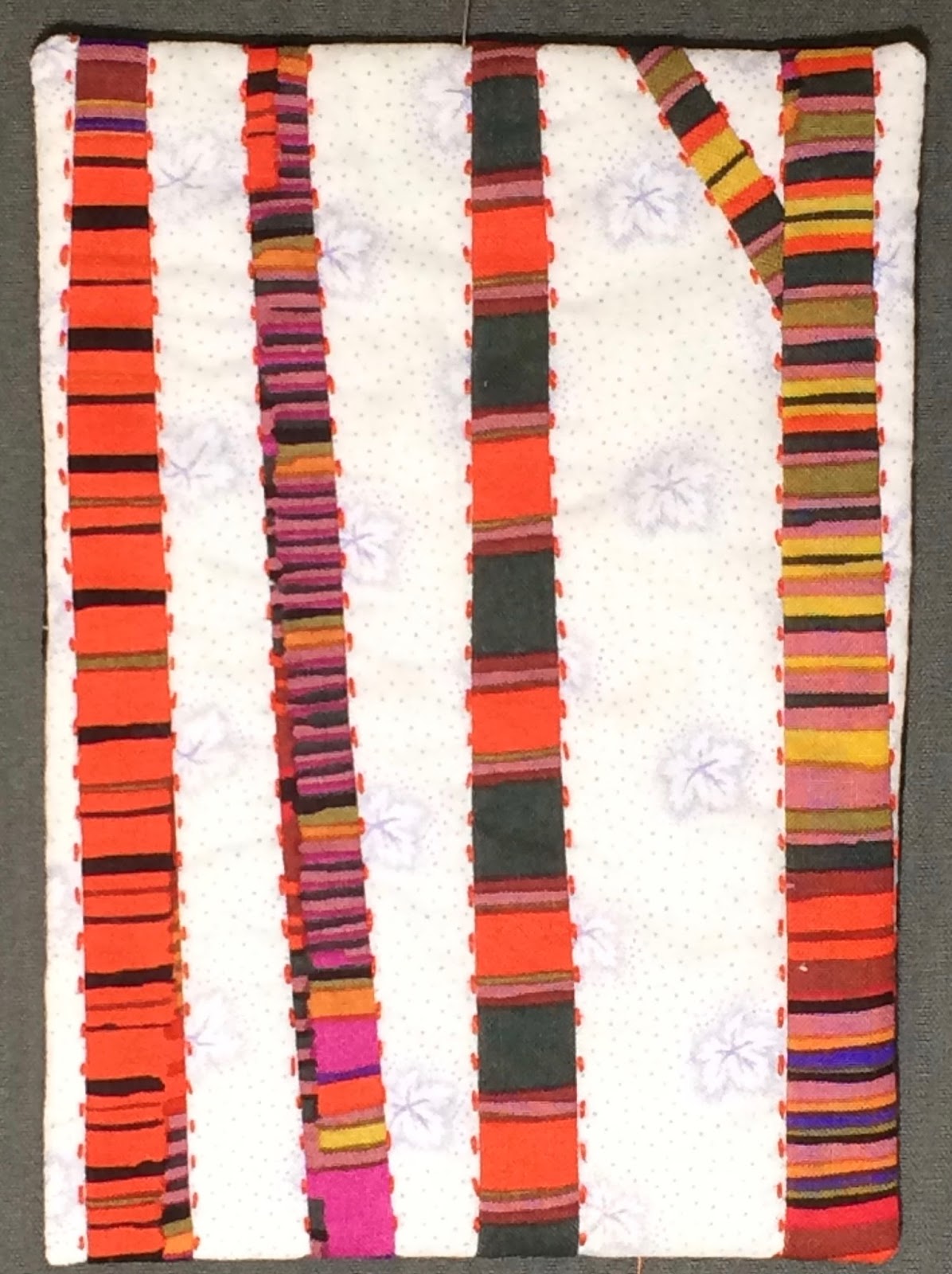
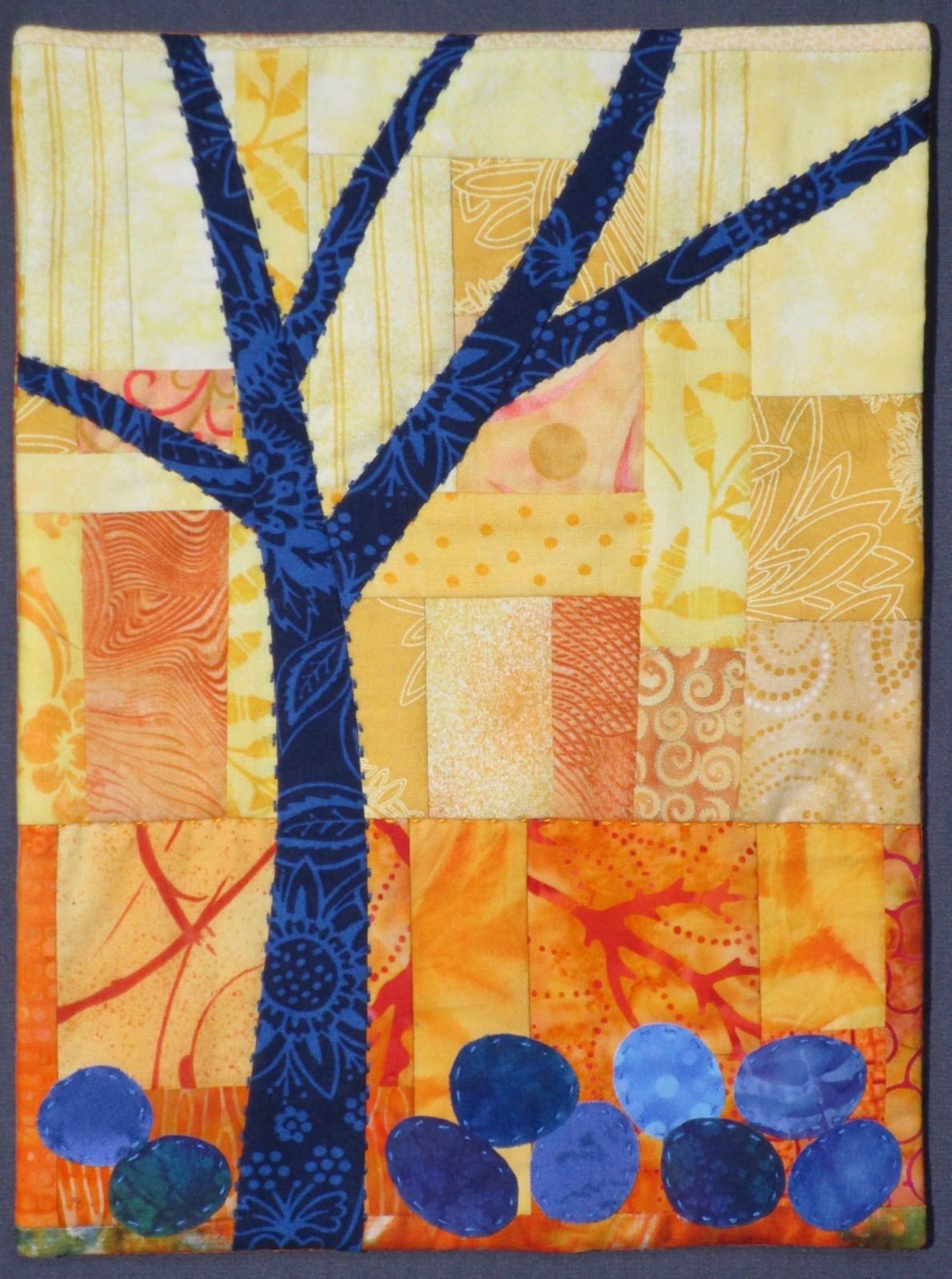
This week also saw me completing my 8 1/2" x 11" entry to the FAN exhibit, "From a Tiny Seed". When I heard the theme, it made me think about trees, and how the great trees around us here on the west coast all began their lives as a tiny seed. How incredible is that! I know I often think of trees as permanent fixtures, and it's always a shock when I hear of trees that have ended their lives. Just this week, a friend from New Brunswick told me that the giant elms that graced the Officers' Square in Fredericton have almost all come down now. I thought they'd be there forever, and that I could go back and visit them again one day. But they are growing things just like us, and some are just starting their lives, while others are getting older.
Trees are also a recurring theme in my 100 Day Challenge. I've been trying out different backgrounds  in the last couple of weeks, and now I'm longing to make something a little larger. But I must be patient and wait until the Challenge comes to a finish. I've already let myself get a little bit behind in finishing "Fern Walk" and "Blue Tree". But I'll soon catch up, and this practice on a small scale has been good for me in many ways.
One of the key things, is that I have a clearer idea where I want to head to next. I've had a number of "aha" moments, such as when I realized that I want to return to this my tree series. And that I want to use bright colours in doing so, and that I want to lean towards abstraction in depicting my trees.
I'm very happy with my most recent leaves, which have evolved since I first started making them in early January, and I have the sense that they will be included in some new work too.
Recently I've been trying out different backgrounds. And different patterns of hand stitching. I have enjoyed using perle cotton enormously, and feel pretty sure that I will continue with this too. Now I don't feel I've finished something until I've added some hand stitching.
Even what shapes are most satisfactory to me has become clearer with time. And interestingly, while windows still intrigue me, they've become less of a focus. Houses too. I think both will be playing supporting roles in what I do next. Of course all of this is open to change, but right now I think this is where I'm heading. But I can only really see far enough ahead to keep moving, and who knows what might be around the next corner. 

Tuesday, March 13, 2018

Filed Notes from New Zealand - New Work

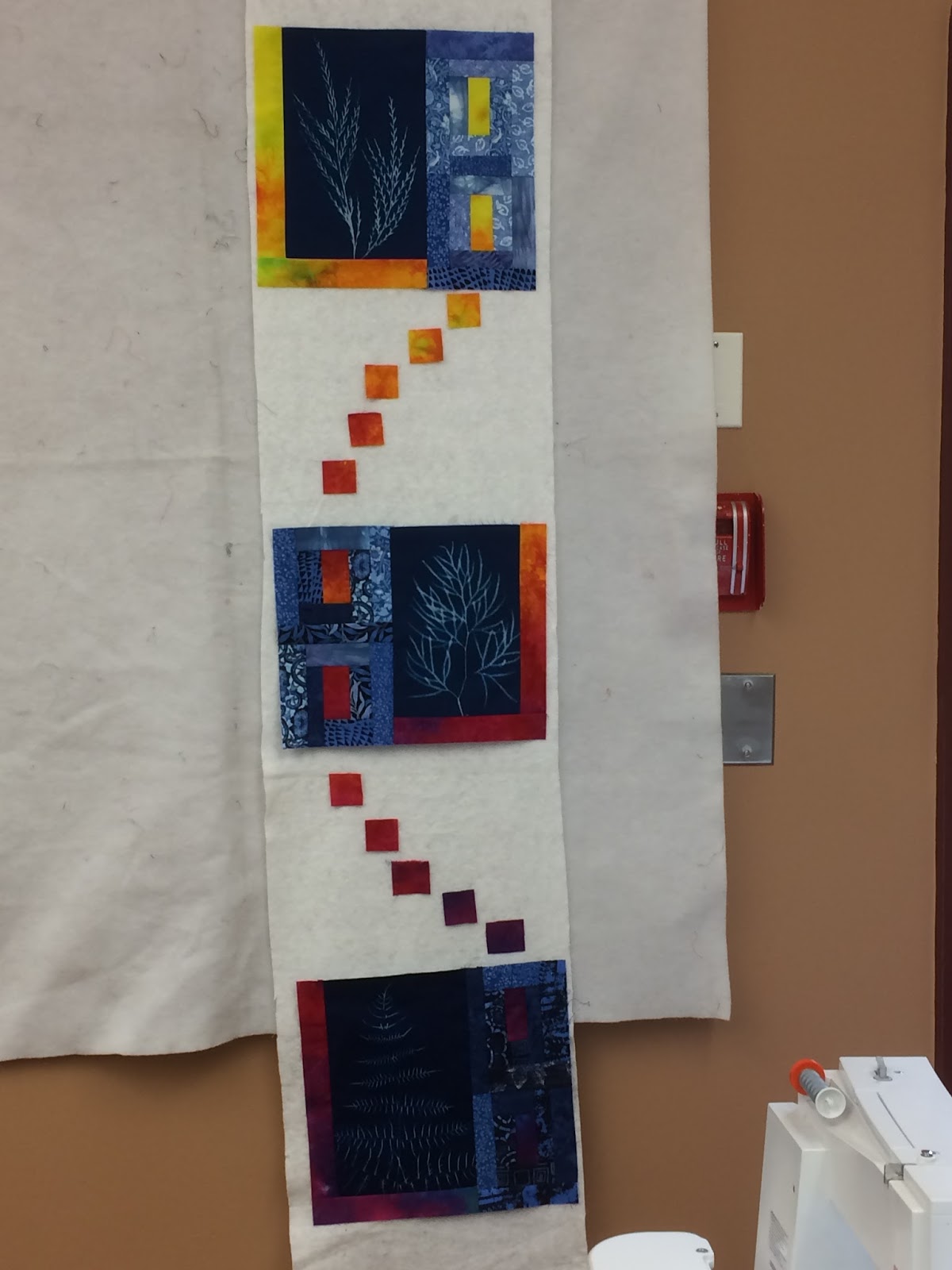
I have been playing with cyanotype printing again. While in New Zealand, I made more prints with ferns and various leaves, and now I'm working on a piece which includes three of these prints. The process itself is most satisfying, using fabric already prepared with the necessary chemicals, and laying the pressed fern on the fabric, holding it in place with a glass plate, and then exposing it to direct sunlight until the prepared fabric becomes a muddy brown. When it's rinsed in cold water and dries in the light, the fabric becomes a rich, dark blue, while the fern or leaf imprint turns a light blue-white.
I have used both red and yellow to offset the blue in previous pieces. This time I decided to use a piece of hand-dyed fabric from Ricky Tims, that allowed me to use lighter colours at the top of the piece, and progress to the darkest colours at the bottom of the piece. This latest addition to "Field Notes from New Zealand" is being made for an Surface Design Association exhibit, and must measure 12" x 60-72" when completed.
This is the portion at the bottom of the work. The fern seems a bit dark in this print, but I will be doing some hand-stitching in off-white to emphasize some of the fronds so hopefully they will show up a little better.
With the three focal blocks made, I next needed to work out how to join them together. The theme of the exhibit is "Pathways", so my goal was to create an implied path using a run of the colours used to border the fern prints. I used strips of blue offset with narrower strips of navy to do this.
Once I'd joined all the blocks together, I basted it to a reclaimed New Zealand wool blanket - heaven to needle through - and began to add some hand-stitching. Which only leaves the backing and facing to be added. So back to the studio and back to work I must go. I'll be sure to post a photo of the finished work next week! 


Tuesday, March 6, 2018

The Longing for Roots

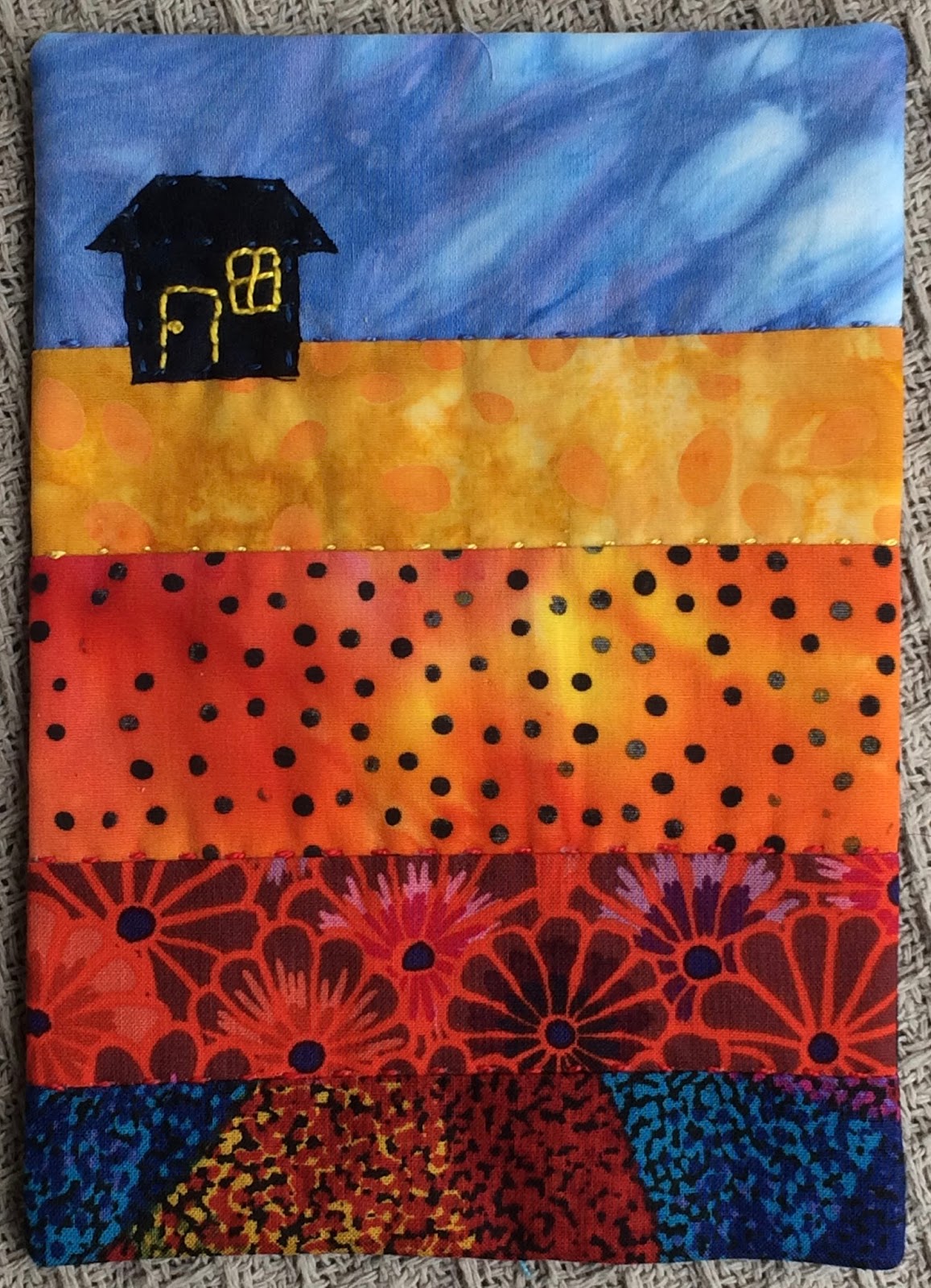
No sooner had I finished writing last week's blog post, than I began to make a small piece, simply called "Roots". I had been writing about little houses turning up in my 100 Day Challenge pieces, and commented that it was no surprise for someone who moved so many times while she was growing up. How I longed to stay in just one house, to have the same neighbours forever, to have a place to call my own. How I hated it when my father would announce "We're moving to Toronto", or "We're moving to Edmonton", or we're moving to Germany. So yes, little houses have come to symbolize so much for me - most of all, a sense of belonging.
Which got me thinking, why not create a small piece that captures this longing for roots. I knew I would be attending a quilting retreat this coming week, which always includes a challenge. And this year's challenge is to respond to the theme "Roots" - right in line with my meandering thoughts. I often opt out of these challenges, especially if they take me off track from what I'm working on at that time. But this time I thought give it a try.
And this was the result. Roots - longing for a place to call my own. No accident, I think, that this little house is a bit like our cabin on Hornby. The irony, of course, is that even if you live in the same place and same house for a very long time, nothing stays the same forever. People who were once counted as friends move away, or perhaps I have moved away mentally, if not literally, from others. Maybe the roots were there all along, and had more to do with being part of the same family through all the moves, and now, having my own family with its own roots. Lots to muse about while I did the hand-stitching. It's not my best work, this piece, but I enjoyed the process, and after all, that's what really matters most. 

Tuesday, February 27, 2018

Keeping on Doing the Work

"The only way to become a better artist is to keep on doing the work". So I wrote last week in thinking over what I learned during my online class with Lisa Call. I've been pondering those words a little more in the last week. I think that somewhere deep down, I thought (hoped?) that if only I chose the "right" series to work on, the "right" subject matter, the best techniques and the absolutely most perfect fabrics, that then my work would stand out, and be the best that I could achieve. But the truth is that there is no magic formula that will guarantee success, but only the realization that I need to keep on making, and in time, with a string of both successes and failures behind me, I will get closer and closer to making work that is authentically mine. The 100 Day Challenge is a proving to be a practical-hands-on experience of that very truth.
Before I made the first leaf, I agonized about what the 100 pieces should be - should they all be leaves, or all windows, or all trees, or all abstract? I finally settled on leaves, because I wanted to figure out how to make them using piecing and adding hand-stitching, and because the shapes and varieties and uniqueness of each one are endlessly fascinating to me.
I used different colour combinations, and added log cabin borders to them all. Some leaves were more successful than others. I liked the rounded shapes of these better than the skinnier leaves, for example.
One day I thought I'd make a tree or two to add to the collection. After all, I thought, leaves and trees are related. And I liked the result, so added more of them from time to time.
 Sometimes I chose more improbable colours for my leaves, or at least different colours.
One day I wondered what would happen if I used a darker background instead of the light background I had used up until then, and then a couple of days later, what would happen if I pieces the trees, rather than using one solid fabric.
 One day I wondered if I could make tree trunks and branches with a gentle curve to them.
And somewhere along the way I introduced windows, wondering to myself what it would be like looking out at the forest through the windows, or coming home after a walk through the woods. I realized that I was adding my own stories to each little work.
And somewhere along the way I started making little houses. Windows and doors and houses find their way into my work over and over again. As someone who moved 23 times by the time she was 21, the longing for home and for roots is a huge part of who I am, and here it was appearing in this series of small works. 
The little house piece also brought me back to my favourite colour palette again. And a few pieces were made then that were abstract play with colour. After all, I reasoned, why not do something a little different, just because it pleased me? Surely that is reason enough.
Abstract leaves appeared too. And grey borders - a brief respite from the intense colours I'd been working with for several days.
Along with the occasional landscape. And so it goes. One small 5" x 7" is made and suggests another. Even as I'm making one, I'm wondering to myself, "what if I . . .?" What if I used analogous colours? What if I used a dark background and a light-coloured leaf? What is I added more or different stitching? What if I used the scraps left from one piece in the next piece? The possibilities are presenting themselves day after day. And so far (Day 58), I haven't run out of ideas. And so the Challenge is proving a wonderful exercise in "Keeping on Doing the Work" - the realization that I don't have to know where all of this is taking me, I just need to keep turning up in the studio and making. Or to put it another way, the process is what matters, and it's OK that I don't know where it will take me. So there is magic in it after all, just not the kind I had been looking for. 


Monday, February 19, 2018

Mussels and Limpets

On a recent beach walk, when the tide was out, my grandson and I started noticing all the limpets hanging on to the rocks. He tried to pick one off. It's stuck, he said, looking to me for help. Even a very, very strong person couldn't lift a limpet, I told him. Later I read that limpets move about a metre a night, scraping algae and seaweed off the rocks. It seems they're a herbivore, and the same "teeth" that let them cling to the rocks also lets them eat the food they find where they're anchored, in the intertidal zone. 
Mussels too hang on to their rocky homes for dear life. usually in large groups. Their tightly closed shells help them remain hydrated during low tide and to withstand being baked in the sun. Which got me thinking about what I need to remember to cling to - a fitting "ponder" as I come to the end of my year-long Masterclass with Lisa Call.
I have learned much in the last year, and feel well equipped to move forward in my daily practice as a textile artist, and if I lose my way, I know I too will need to come back "home" and to cling to my foundation ferociously, or I will not be able to withstand the waves or the sun that will surely come (lack of confidence, confusion about direction, build up of clutter, to name just a few), any more than the limpet can.
When I think about the specifics of what I've learned in the last twelve months, it is both hugely personal, and something I want to share with kindreds in this creative life. In spite of my hesitation, I'm willing to give it a shot, because I have gained so much from being on the receiving end of wisdom and insights from so many others.  There's something in the sharing of our stories that empowers us all to move forward.
I am just beginning this process of reviewing the year and identifying the most important lessons learned, so I will go slowly. So in no particular order, these are some of the things that come to mind:
1. The only way to get become a better artist, is to keep on doing the work. Why this isn't more self-evident, I really don't know.
2. Breaking down what I intend to do into small steps is as sure a way of succeeding in doing it as any other way I have ever learned.
3. Having systems in place with which to manage all aspects of my life, including my creative life, helps enormously in getting down to work and wasting a minimum of time.
4. Being accountable to someone else to do what I say I intend to do each week is terrific in helping me stay on track.
5. Looking after my physical health - eating well and exercising regularly - is key to everything else.
6. Celebrating my successes is a good thing to do.
Only six to start with - I want to think a little more before going on. Even six are a lot to think about in any depth.

Monday, February 12, 2018

Filling the Well in New Zealand

"The Artist's Way", by Julia Cameron, has been one of the most important books I've read on this journey to becoming a textile artist. There are many practices that she promotes that I still use daily, such as writing "morning pages". Another concept I continue to find enormously helpful, is that of "filling the well". As artists, she suggests, we are continually drawing from our individual wells (visual images collected by close observation of all that is around us), in making our work. So it is important to keep that well filled, to look after it regularly, making sure it doesn't become stagnant or polluted. One of the surest ways to do this is to expose ourselves to new sights and experiences. 
I have collected stones and seashells and other beach findings for as long as I can remember. This photo is of a few treasures I picked up one day earlier this week. I was looking for curved shapes, and found such an assortment. There's something about noticing the small and often overlooked that allows me to enjoy a place at a deeper level. The grand and beautiful shout out the loudest, but it is the small, almost forgotten particularities that I remember the longest. And that fill my own personal "well".
It was raining the day I took these first few photos, but the darkened sand provided a perfect foil for this pink and cream seaweed, as well as for my collection in the photo above.
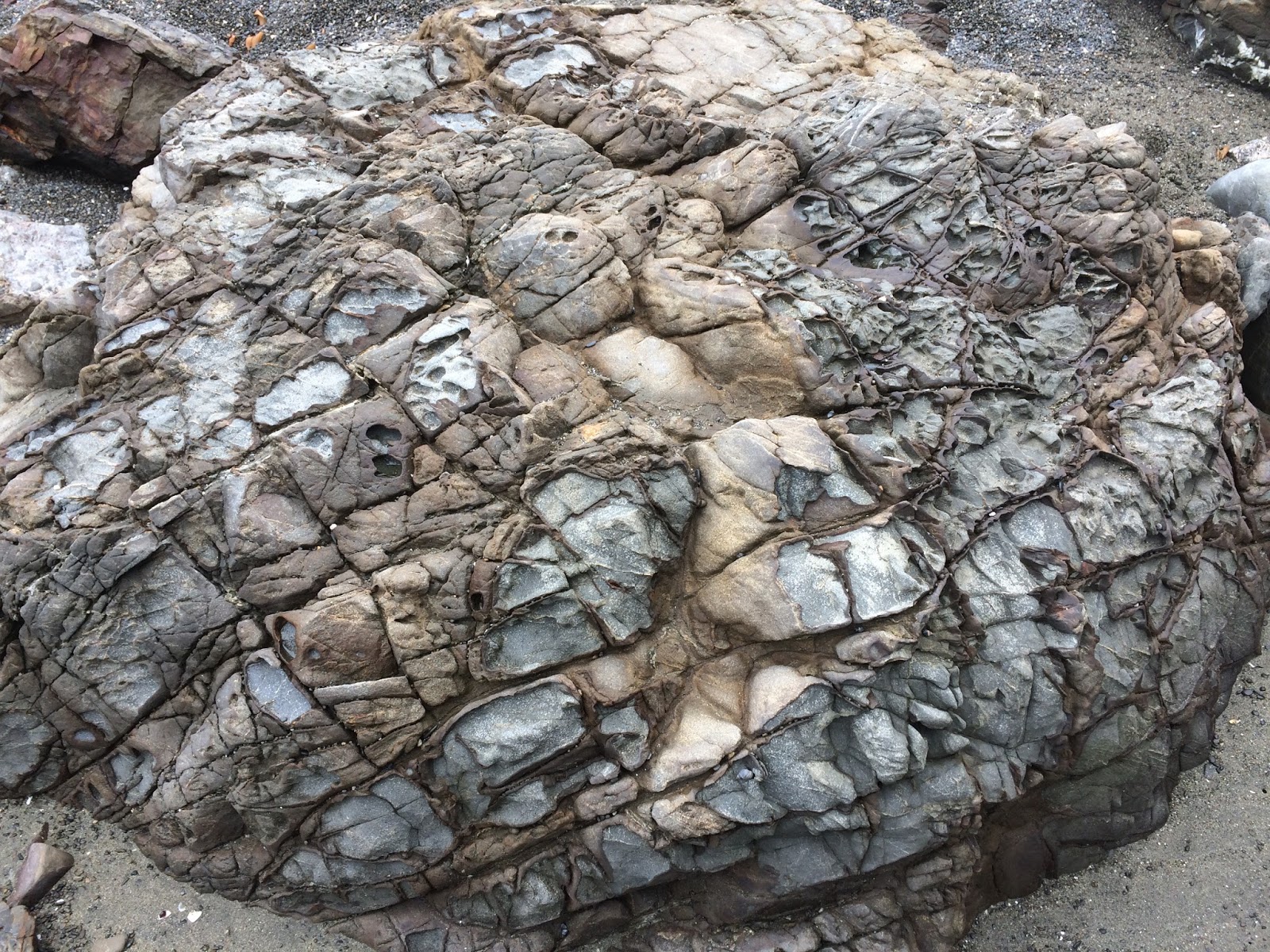
Rocks are another favourite subject. This one is clearly too large to bring home with me, but the texture was amazing. What made those criss-cross lines, I wondered? The irregularities of it and the diagonal lines are amazing. It reminds me of a dried out creek bed, or a map of some sort. I could construct an entire fictional land based on this one rock.
And what are these odd pinecone like things? They look like so many mouths open and chattering at the same time. I suppose each one is a seed pod, but it has me thinking about how much talking we all do and how poor we are at listening. More material for the "well".
I stopped to take a photo of a thistle, and by the time I was ready with my camera, it was being visited by a bumble bee, working hard to extract what it needs to make honey.
And just a little further along the track we almost missed this tiny green frog. He jumped out of our way just in time. Near misses - self-preservation - fitting in with your surroundings. This image takes my mind in so many different directions.
Maori people have a word for these tall grasses that means "wind socks", so my daughter tells me. They flex in the wind, and it's that flexing that allows them to survive, and not break. To bend and not break. More food for thought. More for the "well".
I don't even know what these yellow weedy flowers are, but what a gorgeous contrast to the deep blue-turquoise of the ocean behind them, and the verging on lavender sky.
Again, I don't know the name of the plant in the foreground, but I love how it glows in the sunlight, and how well it stands out against the long grasses and trees behind it. There's something about this photo that's like a parable to me.
And if you are accompanied on one of your walks and treasure hunts by a young man who has much or even more enthusiasm for it than you do, you can count yourself as most fortunate. I think we all returned home from our walks with our wells filled almost to the brim.

Tuesday, February 6, 2018

What Comes Next?

The 100 Day Challenge continues. By the end of this week I will have reached Day 40, and I am determined to complete all 100 days. In the last week, I have made some more tree trunks from striped fabric, another windows composition, three more leaves and two more bare branch trees - most of those are shown here.
But I'm beginning to battle this desire to do something different. Maybe a few landscapes or perhaps a few abstract pieces. What I'm wondering is, would it be better to stick with my original concept of just trees and leaves and push that a bit further, or would a little variety make it more interesting, both for me as the maker, and for the viewer?
I had imagined a wall full of 100 leaves and trees, and that the entire composition would be stronger for the unity. This may still be true. The windows were introduced because I imagined looking out on a forest, or coming home from a walk through the forest. And because I like using windows in all my work. Hmmm . . . something to let simmer for awhile.
The bare-branched trees made with gently curving lines are also very pleasing to me, and I wonder about making a larger piece incorporating larger, longer trees made the same way. Perhaps when the 100 Days are over, I can explore this possibility.
Right now, though, I will do well to maintain the practice of making one small 5" x 7" tree or leaf each day. I know this has to come first each day, or I will lose the rhythm. The discipline of this is good for me. And instead of entertaining questions of doing something a little different, I should listen to the advice posted by my desk "Just Do It".